A Watch Party Built Around One Scene
A watch party built around one scene gives friends a relaxed way to share what they notice, with one open question guiding the conversation.
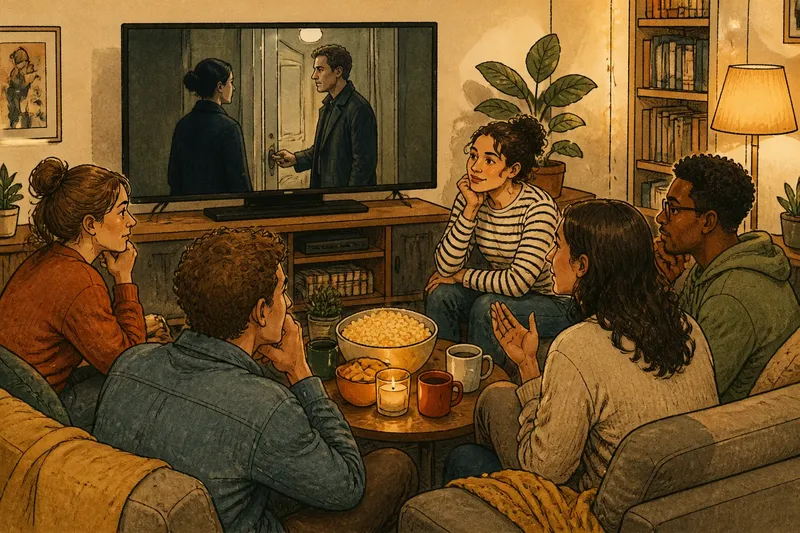
You have a film paused on the frame just before a character opens a door, and a few friends are settling onto the couch with snacks. Instead of watching the whole movie together, you have planned a watch party built around one scene: a short, shared viewing followed by a conversation shaped by one open question.
The point is not to turn a favorite moment into a quiz or defend a single interpretation. A carefully chosen scene gives everyone the same material to notice, while one roomy question lets each person bring a different kind of attention to it: dialogue, performance, sound, editing, or a memory of watching it before.
Choose a scene with room for more than one observation
Start with a scene you genuinely want to revisit, but ask what it offers someone who does not already love it. A scene can be compelling because a glance changes the mood, a pause makes a line land differently, or background activity quietly complicates what the characters say.
Choose a complete moment with a beginning and an ending, rather than a fragment that depends on a long plot explanation. It might be a conversation at a kitchen table, a silent exchange in a hallway, or a musical number whose staging gives people several details to follow. The scene need not be famous or technically elaborate; it simply needs something viewers can point to.
Imagine you are hosting friends who know a comedy well, while one guest has never seen it. You choose a self-contained scene in which two characters try to act casual during an awkward visit. The newcomer can follow the immediate situation, while longtime fans may notice how a repeated gesture or a change in delivery reshapes the joke.
Before settling on the choice, consider whether the scene contains a moment you would be comfortable discussing with this group. A tense argument or a frightening sequence may invite useful observations, but it can also make a casual gathering feel heavier than intended. You can choose something gentler, give a brief content note, or pick a different scene without needing to justify the decision.
Make the viewing arrangement easy to follow
Keep the setup modest. Use the television, laptop, or projector you already have, and check that the scene can be cued without a lengthy search while people wait. If you are streaming, confirm that the title is available to your group and that playback controls are easy for you to reach.
Decide whether everyone will watch together in person or join remotely. For an in-person gathering, place seats so guests can see the screen without turning away from one another throughout the discussion. For a video call, share the screen with device audio enabled if the service supports it, and tell guests how you will handle playback so nobody has to guess whether to press play locally.
Keep the scene’s sound clear enough that quiet lines and musical cues can be heard. Close a noisy window or lower background music rather than raising the volume without regard for the room. Subtitles can help guests follow fast dialogue, unfamiliar accents, or a scene with overlapping speech; ask the group what works for them.
It also helps to make the gathering feel like a visit, not a screening event. Set out water, tea, or a snack before the scene begins, then leave the viewing area uncluttered enough that guests can see. If someone arrives late, offer a quick explanation of the setup rather than restarting automatically; a restart is useful only if the group agrees it would help.
Ask one question that opens the scene instead of closing it
Prepare one open question in advance. It should invite a range of answers rather than ask guests to identify a correct meaning. “What changed for you during that scene?” can lead to comments about a performance, a shift in the relationship, or a sound that changed the mood.
Other useful questions include “What detail stayed with you after the scene ended?” and “Which moment felt different from what you expected?” Choose the one that suits the scene, and resist adding a string of follow-ups before anyone has had time to think.
In the imagined comedy gathering, you ask, “What made the visit feel awkward to you?” One guest points to the characters’ overly careful politeness. Another remembers a character folding the same napkin repeatedly, while the newcomer mentions how the pauses made the room feel uncomfortable. Their answers are different, but each refers to something visible or audible in the scene.
That is the useful distinction between an open question and a trivia prompt. A trivia prompt tends to sort people by what they recall; an open question gives them permission to notice, interpret, or simply describe a reaction. You can still ask about a specific line or gesture later, but the first question should leave several doors open.
Let the first viewing belong to the scene
Introduce the selection in a sentence or two: name the film or show, explain where the scene sits if that context is necessary, and mention any relevant content note. Then play it without pausing to point out details. A host who narrates every glance can make guests feel they are expected to find the same meaning.
Afterward, allow a little quiet before asking the prepared question. People often need a moment to separate what happened from what they think it meant. If one guest answers quickly, thank them and invite others to add an observation, without asking anyone to match the first interpretation.
In the invented gathering, the host waits while the awkward visit’s last beat settles, then asks the question. The napkin detail leads to a short exchange about nervous behavior, but nobody has to decide whether the character is anxious, dishonest, or merely uncomfortable. The scene has created enough shared reference for a conversation without requiring agreement about the character’s inner life.
Do not treat silence as a problem to solve at once. Some guests prefer to listen before speaking, and a low-key event does not need every person to contribute aloud. You can make room by saying, “We can sit with it for a moment,” or by inviting people to point to a detail rather than explain a full interpretation.
Use a replay only when it answers a real curiosity
A second viewing can be satisfying when the group has identified a moment it wants to revisit. Ask first: “Would it help to see that pause again?” If people are ready to move on, let the scene remain a single shared experience rather than replaying it by default.
If the group wants to return to a detail, cue a short passage and explain what prompted the replay. Perhaps someone wants to hear a line beneath a burst of laughter, or compare a character’s expression before and after another person speaks. Keep the question focused on what the group can observe; avoid presenting the replay as proof that one interpretation must be right.
For example, the hypothetical host might replay the moment when the napkin is folded, after two guests mention it. The group can notice that the gesture continues while the character says everything is fine. That observation may strengthen one person’s reading and leave another unconvinced, which is a perfectly workable result.
Some services make precise cueing awkward, especially during a remote gathering. If searching for the exact moment would interrupt the evening, skip the replay or return to the whole scene. The conversation does not depend on perfect playback control.
Keep the conversation welcoming and grounded
Make it clear that guests do not need specialist vocabulary. Someone can say “the room got tense” without naming blocking, framing, or sound design. If a person does use a technical term, they can explain it in plain language so the discussion stays open to everyone.
Invite observations before interpretations when the conversation gets stuck. “What did you see or hear that gave you that impression?” is a gentle way to bring the group back to the scene. It does not dismiss anyone’s response; it gives others a concrete detail to consider.
Keep disagreement proportionate to the stakes. A guest may read a smile as affectionate while another finds it pointed, and neither needs to win. Avoid turning a casual exchange into a test of who knows the story best, especially when one person has watched the title many times and another is encountering it for the first time.
If a guest shares a personal association, let them decide how much to explain. A scene can remind someone of a family habit or a difficult experience, but the host does not need to ask for private details. A simple acknowledgment and a return to the group’s chosen question can respect the contribution without making it the evening’s new subject.
Decide what makes a satisfying ending for the gathering
A one-scene party does not need a formal verdict. Once the conversation has slowed, ask whether anyone wants to add one last observation, then close with something ordinary: offer another snack, talk about what to watch next time, or let guests head home. The scene can remain unresolved.
In the imagined gathering, the group does not agree on why the character keeps folding the napkin. One guest sees nerves, another sees an attempt to look composed, and the newcomer simply remembers the awkward pauses. The host ends the discussion by asking which detail each person will probably notice on a future viewing, then lets the evening move on.
The result is not a definitive reading of the comedy. It is a shared account of how one small scene offered different viewers different points of entry. That is the practical value of a watch party built around one scene: it gives a group a common moment to look at without asking everyone to experience it the same way.
What should guests know before they arrive?
Should everyone know the movie already?
No. A self-contained scene can work for newcomers if you give only the plot context they need to follow the immediate situation. Avoid revealing later turns that are not necessary for understanding the moment.
How long should the conversation last?
Let the group’s interest set the pace rather than assigning the discussion a fixed duration. If comments begin to repeat or guests shift toward other conversation, that is a natural point to wrap up.
Should the host explain what the scene means?
Offer context when it helps people understand the setting or relationships, but do not present one interpretation as the answer. The open question works best when guests can respond to details in their own words.
What if nobody wants to speak first?
Give people a quiet moment, then offer a small prompt such as, “Was there a sound or gesture you noticed?” You can also share your own brief observation, while making clear that it is an invitation rather than the standard everyone should follow.