The Myth of the Director as a One-Person Show
The director’s role is central, but a film or television production depends on specialists whose choices shape the images, performances, sound, and rhythm audiences experience.
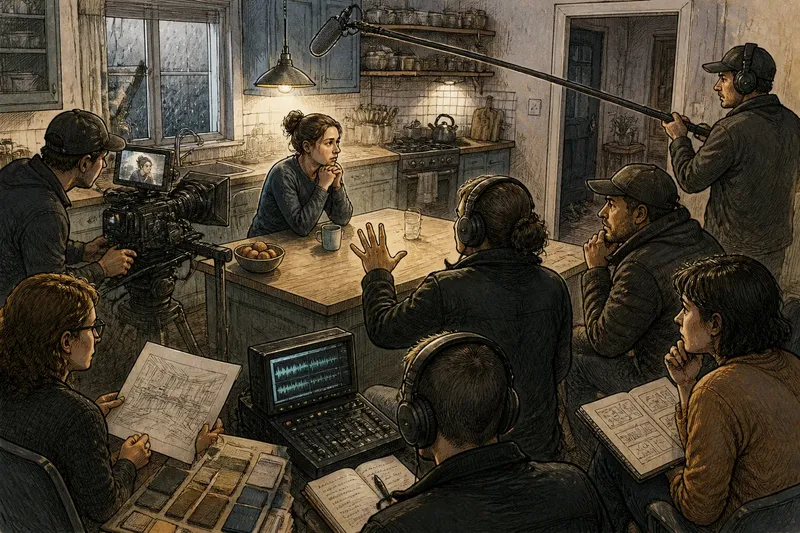
On screen, a tense pause may look like a single decision: the director asks an actor to wait before speaking. In the finished scene, that pause also depends on the framing, the actor’s timing, the room’s sound, the cut that follows, and choices made by other specialists. Understanding film and television production means seeing the director not as a one-person show, but as the person who helps a group of craftspeople make a shared dramatic intention visible.
The director leads a process rather than making every choice
A director interprets the script and guides its translation into performances and images. That work includes communicating what a scene should accomplish, helping actors find playable choices, and coordinating with department heads so their contributions support the same story. The director’s authority can be substantial, but authority is not the same as personally doing every job.
A useful distinction is between direction and execution. Direction sets priorities and resolves creative questions; execution involves the specialized decisions and physical work that realize those priorities. A director might ask for a room to feel exposed and unforgiving. The production designer, cinematographer, lighting team, and sound department each have distinct ways of making that feeling legible.
The exact division of responsibility varies with the production’s scale, format, schedule, and agreements. A small project may combine duties that a larger show assigns to separate people. Even then, collaboration does not vanish; it takes a different shape.
The script begins the conversation
The screenwriter gives the production a structure of scenes, actions, dialogue, and dramatic turns. That structure guides the work, but a script usually cannot specify every detail the audience will perceive. A line such as “She realizes he has been lying” names a dramatic shift, not the precise look, camera position, sound, or edit that will communicate it.
The director develops an interpretation with the writing team and other collaborators. They may discuss what information a scene should reveal, which character’s experience should dominate, and how much the audience should understand at each moment. Those questions help departments make choices that serve the same progression rather than simply decorate the scene.
In television, the process can involve a showrunner, a lead writer, a director, and a team of producers. The showrunner often oversees the series’ larger creative direction, while an episode director works within the established world and coordinates the episode’s realization. The roles are not interchangeable, and their boundaries depend on the production.
Each department makes story choices in its own medium
Production design shapes the physical world: locations, sets, colors, furniture, and objects. These elements can suggest a character’s habits, resources, or changing circumstances before anyone explains them. A prop is not only something an actor handles; its condition, placement, and continuity may carry meaning from shot to shot.
The cinematographer, also called the director of photography, works with the director to shape how the scene is photographed. Decisions about composition, lensing, camera movement, exposure, and lighting influence what feels important or withheld. The cinematographer and camera and lighting crews make those images through technical and artistic work, with choices that respond to the location and the scene.
Costume and makeup teams give performers a visible relationship to character and setting. Clothing can signal a deliberate change, a routine, or an attempt to fit in; hair and makeup choices can support continuity as the story moves between scenes. These decisions are developed with the director and other relevant collaborators, not merely added after the performance is complete.
Sound work extends beyond dialogue. Production sound teams record voices and the surrounding environment during filming, while sound editors and mixers shape dialogue, effects, ambience, and music in postproduction. A quiet room can feel uneasy because of what the audience hears, what it does not hear, and how sound shifts around a character’s attention.
Editing determines how recorded material becomes a sequence. An editor selects and arranges shots, adjusts pace, and helps clarify the relationship between actions and reactions. The director participates in shaping the cut, but the editor brings a distinct craft and a close understanding of how timing, selection, and transitions affect the scene.
How does collaboration change what reaches the screen?
Who decides what the audience sees?
The director helps establish the scene’s point of view, while the cinematographer and camera team shape the available images and the editor chooses how those images are arranged. Their decisions interact: a performance might be captured from several angles, but the edit determines which expression or reaction becomes part of the audience’s experience.
Does the director give actors exact instructions?
Sometimes a director gives a specific note, but effective direction can also involve asking a question, clarifying an objective, or identifying what the scene needs to change. Actors bring training and interpretation to the work, and their choices can affect blocking, emphasis, and the emotional texture of a moment.
What happens when departments disagree?
Creative differences are usually worked through by returning to the scene’s purpose, practical limits, and the production’s leadership structure. A director may make or help resolve a decision, but a useful solution often grows from a department’s expertise—for example, finding a workable way to preserve a visual idea in a difficult location.
Why does the finished scene feel unified?
Unity comes from many choices reinforcing one another, not from every department making identical choices. A restrained performance, uncluttered framing, quiet sound, and measured editing can all serve a subdued scene while remaining distinct forms of work.
A scene shows how one intention becomes many choices
Say a production is staging an invented scene in which a character waits alone in a kitchen for a family member who has not come home. The director’s starting point might be that the character is trying to stay composed while fear grows. That intention becomes useful to collaborators when it is expressed as something they can interpret in their own work.
The production designer might propose a kitchen that appears used but unusually orderly, suggesting the character has been keeping busy. The cinematographer could discuss how to hold the character within the room rather than constantly moving closer. The actor might build the wait from small, ordinary actions that become harder to finish. The sound team could preserve familiar household noises while avoiding a cue that announces danger too early.
When the scene reaches the edit, the director and editor might consider whether a long view of the empty doorway keeps attention on the waiting, or whether a cut to a half-finished task conveys the character’s distraction more clearly. Each choice belongs to a different craft, yet each answers the same dramatic question: how does the audience experience waiting alongside this person?
The finished scene would not be the director’s intention copied onto the screen. It would be a coordinated result shaped by the script, available locations, performances, images, sound, and edit. If one element changes, the others may need to adjust; collaboration is an ongoing exchange, not a handoff that happens once.
Production constraints shape the collaboration
Schedules, locations, equipment, budgets, and the needs of cast and crew affect what a production can accomplish. Those limits do not make creative decisions automatic. Instead, departments offer alternatives that preserve the scene’s purpose while accounting for what is available and workable.
For instance, a location may not allow the planned camera movement or lighting setup. The cinematographer and director can consider a different composition, while the production design and sound teams help the setting continue to support the scene. A changed approach may alter how the audience reads the moment, so the relevant collaborators need to consider that effect rather than treating the substitution as purely technical.
Preparation helps those conversations happen before filming, but not every question can be settled in advance. An actor’s discovery, a shift in weather, or the behavior of a location may prompt a revision. The director helps the team judge whether the new option serves the story, while specialists identify what can be changed without creating avoidable problems elsewhere.
Credit can hide the work that made a scene possible
Marketing and publicity often center the director because an audience can easily recognize a single name as a point of creative identity. That emphasis may make a production easier to discuss, but it can also conceal the number of people whose judgments and labor shaped what appears on screen.
It is reasonable to talk about a film’s direction or a director’s style. The useful distinction is to treat those terms as descriptions of leadership and creative pattern, not proof that one person performed every craft. A director’s approach becomes visible through collaboration, including the decisions that other department heads contribute and the work that performers bring to a scene.
This perspective also makes viewing more attentive. A striking composition can invite a question about the cinematography; a convincing room can point toward production design; a sudden change in emotional pace can come from performance, editing, or both. Rather than guessing which individual deserves sole credit, notice how the parts work together and consider what each one adds.
The director’s role is strongest when it connects specialists
A director’s influence is real, but it is most accurately understood as the work of interpreting, communicating, and making choices across a team. The script supplies dramatic material, performers embody it, and departments build the conditions through which viewers see and hear it. Their contributions are not interchangeable, even when they serve a common aim.
The next time a scene feels precise, look beyond the person whose name leads the credits. Ask what the actor, camera, setting, sound, and edit each contribute, and how those contributions meet. That habit gives a fuller account of filmmaking—and a clearer understanding of why the director can lead a production without being its one-person show.