Live Audience or Camera: Two Kinds of Comic Timing
Live audience or camera timing changes how a pause lands. Learn how room response and screen editing shape comic beats, punchlines, and performance choices.
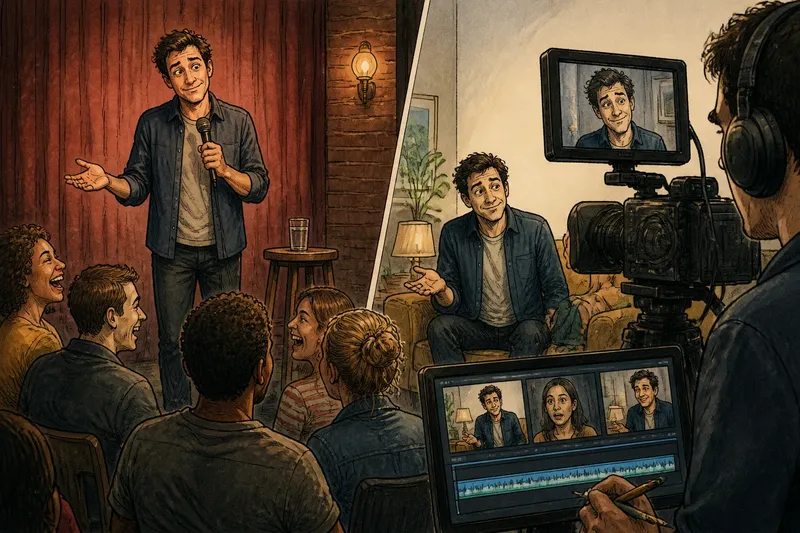
In a small theater, a performer holds a look while laughter rolls from the front row toward the back wall. On a screen, the same look may feel slow unless a cut, reaction, or sound gives viewers a reason to stay with it. Live audience or camera timing depends less on delivering a line faster or slower than on shaping the space around the laugh.
The joke may stay the same, but a live room and an edited scene give the audience different ways to receive it. Those differences affect pauses, punchlines, reactions, and the choices performers and editors make.
Live pauses have to leave room for a room
Onstage, a pause is shared time. People may laugh at different moments, and laughter from one part of the room can prompt another part to join. A beat that ends too soon can cut off the response; one that stretches without purpose can make the audience wonder whether the performer has lost the thread.
The useful cue is the room’s changing sound, not a fixed count. A performer can keep a relaxed expression and let the laugh gather, then continue as it begins to settle. That makes the pause feel like part of the exchange rather than empty time.
Screen pauses need a visible reason to continue
Screen comedy does not share one physical room with its audience. Viewers may be watching alone or with others, and the picture can move on before a response reaches the performer. A pause therefore needs to remain legible: a face, gesture, object, or change in framing can hold attention while the line’s implication lands.
Close framing can make a small eye movement carry weight, while a wider shot may let a physical gag unfold. Editors can also trim the space around a reaction. The goal is not simply to remove silence, but to preserve the beat that lets viewers understand what the character has noticed.
Live punchlines meet unpredictable laughter
A stage punchline arrives in an environment the performer cannot fully control. Someone may laugh early, a late listener may catch the joke after the first wave, or a quiet room may leave the line exposed. Performers can make the words clear and leave some air afterward, giving the audience a chance to respond without speaking over the next thought.
Imagine a fictional comic in a neighborhood theater describing a character who keeps bringing an umbrella indoors. The performer delivers the final line clearly, waits as the first laughs rise, then adds the next sentence as the response begins to settle. The expected result is that listeners can hear both the punchline and the follow-up, though the exact pause changes with the room.
Screen punchlines can use the cut as a beat
In a recorded scene, timing can be shaped after the performance. A cut to a silent coworker, a held reaction, or a return to the speaker can function like a pause without asking the actor to sustain it in real time. The edit also determines whether viewers see the setup, the reaction, or both when the joke resolves.
That flexibility brings a tradeoff. A cut that explains the joke too eagerly can flatten the audience’s chance to notice it; a cut that arrives too late may make the exchange feel sluggish. Editors and performers are choosing not only the length of a beat but whose face carries it.
Live audience or camera timing shifts attention in six ways
- Who controls the beat: In a theater, the performer responds to the room’s laughter; on screen, the edit can set the beat before viewers watch.
- Where attention goes: A live audience shares the same stage, while a shot can direct screen viewers to a speaker, listener, or prop.
- How laughter affects dialogue: Live laughter can cover the next words, so a performer may wait; screen editing can position a reaction before dialogue resumes.
- What a pause contains: A stage pause can gather audience response, while a screen pause often needs an expression, gesture, or visual change to sustain attention.
- How reactions vary: Each live performance meets a particular room; an edited scene presents the same chosen reaction to each viewer.
- How timing can be revised: A performer adjusts a live beat in the moment, while editors can reshape recorded pauses and cuts before the scene reaches viewers.
Questions about live audience or camera timing?
Should a performer wait for every laugh?
Not necessarily. A performer can let a laugh crest without waiting for the room to become completely quiet, especially if the next line will remain clear. The aim is to keep the exchange moving without losing important words beneath the response.
Why can a pause feel longer on screen?
A close view can make small expressions vivid, but screen viewers do not share the energy of a live room. Without a useful visual change or a reaction that adds meaning, stillness may read as delay rather than anticipation.
Can an editor change comic timing without changing the dialogue?
Yes. A cut, reaction shot, or trimmed gap can shift when viewers recognize the joke and how long they stay with it. The words remain the same, but the sequence of images changes the beat.
What should a performer preserve in both settings?
Clarity matters in either format: the audience needs to catch the setup and understand what the punchline turns on. A live performer responds to the room, while a screen performance can use framing and editing to guide attention.
Choose the beat that serves the audience’s attention
When adapting a comic scene, ask what the pause lets the audience do. Does it give people time to hear a joke, notice a contradiction, or read a reaction? If the beat carries no new information or anticipation, it may be shortened; if it changes how the punchline lands, preserve its function even when its length shifts.
For live work, rehearsal can focus on clear delivery and flexible space after the line rather than one rigid pause. For camera work, performers and editors can decide whether the shot should stay with the speaker or transfer attention to a listener. The best timing makes the audience’s next response—laughter, recognition, or surprise—feel earned.
Live audience or camera timing is ultimately a choice about where comic energy sits: in the room’s response or in the screen’s sequence of images. When a joke feels slow, look at the beat’s job before simply cutting it. A pause that gives viewers something to notice can be brief and still matter; a longer one earns its place only when the audience has a reason to stay with it.