From Variety Bill to Television Showcase
Learn how a variety-show format holds distinct acts together, diagnose lulls and mismatches, and choose transitions that make a mixed programme feel intentional.
A dance number ends, the applause fades, and the next act is a quiet comic monologue. In a variety-show format, that handoff can feel like a deliberate change of mood—or like the programme has lost its thread. The difference often lies not in making every act alike, but in giving each one a clear place within the whole.
A variety bill gathers distinct performances into one programme; a television showcase adapts that principle to a viewing experience shaped by cameras, edits, running order, and a screen audience. Neither label dictates a single recipe. A bill may be linked by a host, a venue, or a loose theme, while a showcase may use a recurring setting or visual style to frame acts that otherwise have little in common.
When the programme feels like a pile of acts
What causes it: Each performance may work on its own, yet the programme offers no reason to experience them together. A host can announce the next act without creating a larger sense of occasion, especially if the introductions merely repeat names and titles.
What to try: Find a simple connection that can carry the programme without forcing its acts into one subject. It might be a shared venue, a recurring host, a changing set, or a contrast between performance styles. The connection should help the audience understand why these acts share a bill, not claim that they are all doing the same thing.
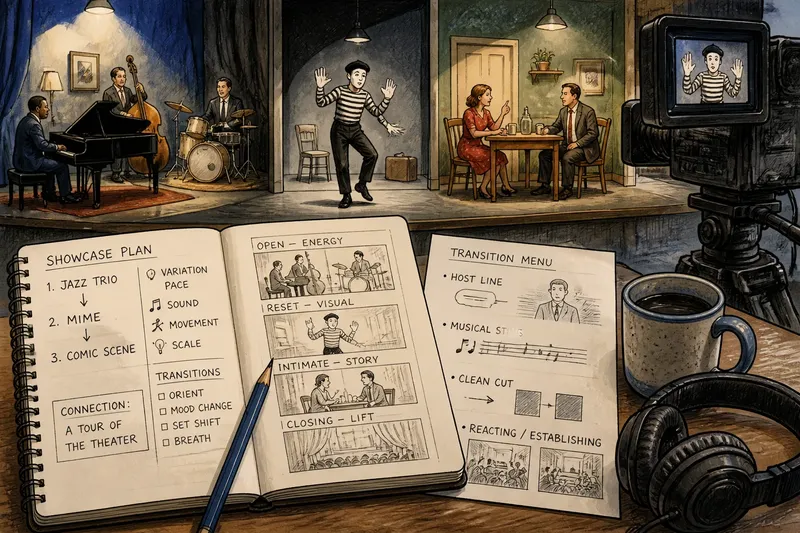
Say a fictional neighborhood theater is preparing a showcase with a jazz trio, a mime, and a short comic scene. The producer could frame the evening as a tour of the theater’s different rooms, letting each act appear in a distinct space; viewers would then have a recurring setting to follow while the performances retain their separate identities.
When the running order creates a lull
What causes it: A sequence can lose momentum when several acts make the same demand on attention. Two extended spoken performances back to back may feel repetitive even if their subjects differ, while a quiet piece immediately after another quiet piece can make the middle of the programme seem static.
What to try: Look at the audience’s experience from one act to the next: changes in pace, sound, movement, and scale matter alongside genre. A lively opening can establish energy; a shorter or more visually active piece can reset attention after a long performance. The order need not build like a dramatic plot, but it should offer variation rather than accidental sameness.
Do not use a running order to disguise an act that does not fit the programme’s available time or technical setup. If a piece needs a substantial set change, its placement should account for that transition rather than leaving the audience with an unexplained pause.
When transitions interrupt the acts
What causes it: A transition can become a performance in its own right. A host may explain too much, a title sequence may recur so often that it feels like a reset, or stagehands and equipment changes may dominate the gap between acts.
What to try: Give each transition one job: orient the audience, introduce a change of mood, cover a practical shift, or provide a brief breath. A host’s line can connect two acts through a shared detail, while a musical sting or a clean cut may be enough when the next performance speaks for itself. On television, the edit can bridge a change of set with a close-up, a reaction, or a short establishing shot rather than a long explanation.
Keep transitions in proportion to the performances they frame. If the audience remembers the host’s elaborate setup more clearly than the act, the handoff is taking too much space.
When one act seems to belong to another show
What causes it: A mismatch may come from the act’s tone, format, or production needs, not simply from its genre. A deliberately intimate ballad can sit beside broad physical comedy if the programme makes room for the shift. But an act that depends on a different audience relationship or a complex setup may feel imported without context.
What to try: Identify what the act asks viewers to do. Does it invite close listening, group participation, surprise, or sustained attention? Then decide whether the programme can prepare viewers for that mode through its placement, introduction, staging, or camera approach. If the act’s essential appeal disappears under the programme’s usual presentation, adapting the frame may help more than altering the performance itself.
This is one reason variety-show formats should not be treated as interchangeable. A theater bill can rely on a shared room and immediate audience response; a television showcase can cut between performers, use inserts, or stage a segment for a camera. The format’s conventions shape how an act is received, even when the underlying performance remains similar.
When the camera makes a live act feel flat
What causes it: A performance designed for a room may use distance, audience reaction, or movement that a screen does not convey well. A wide shot can make a small gesture hard to read, while constant cutting can break the rhythm of an act that depends on watching a performer complete a movement.
What to try: Decide what the audience needs to see and when. A broad view can establish a physical act’s full shape; a closer frame can reveal a facial reaction or a small prop. For music, the image should support the sound rather than compete with it. Editing choices should preserve the act’s timing instead of imposing a faster pace simply because the programme is on television.
The production also needs to distinguish a live audience’s response from the performance itself. Applause and laughter can provide texture, but a reaction shot or audio cue should not repeatedly interrupt a moment that needs quiet.
When a theme feels forced
What causes it: A theme becomes distracting when it asks every act to make the same point or wear the same visual costume. A programme may begin with a useful idea, then over-explain it in introductions, graphics, and repeated jokes until the audience has little room to meet each performance on its own terms.
What to try: Treat a theme as a frame, not a rulebook. It can shape the order, setting, or host’s perspective while leaving room for acts that respond to it differently—or do not refer to it directly. If an act needs a special explanation to fit, keep that explanation brief and specific rather than stretching the theme to cover every detail.
Some showcases work best with a strong through-line; others depend on the pleasure of contrast. A recurring location, host, or visual motif can supply coherence without requiring a shared story. The useful question is whether the frame helps the audience move between acts, not whether every segment can be summarized under one slogan.
Which variety-show format fits the programme?
What makes a variety bill different from a television showcase?
A variety bill often presents performers as parts of a shared event, such as a theater evening or a hosted stage program. A television showcase is arranged for the screen, where camera placement, editing, and segment framing can connect acts that do not share a physical stage.
Does a variety show need a host?
No. A host can provide orientation and continuity, but a recurring set, visual motif, or carefully shaped sequence can do similar work. If introductions add no information or atmosphere, the programme may be stronger with shorter handoffs.
How can unrelated acts feel connected?
Give viewers a modest point of continuity, such as a venue, a recurring presenter, or a changing sequence of performance styles. The connection should clarify the programme’s shape while allowing each act to keep its own tone and audience relationship.
Should television edit every act to move faster?
No. Editing should suit the performance: a physical routine may need a stable view, while a spoken segment may benefit from a close reaction. Preserve the timing that makes the act legible instead of treating speed as a universal improvement.
Make the frame serve the performers
When a variety-show format feels uneven, diagnose the seam before changing the acts: check the running order, the transition, the audience’s point of view, and the amount of framing around each performance. A programme can be cohesive without making every segment match, and it can be varied without leaving viewers to guess why the acts belong together.
Choose the lightest connective device that solves the problem. Sometimes that means moving an act, trimming an introduction, or giving a camera a clearer view; sometimes it means accepting a sharp tonal shift as part of the pleasure. The format works when its frame helps viewers arrive at each new performance ready to see what that particular act is doing.